Patented optical instruments that measure precipitation, flow & turbulence the rest can't.
Scintillation-based weather, AWOS, emissions-flow and atmospheric-turbulence sensors deployed at every U.S. airport, leading refineries, and NASA, NOAA, EPA & U.S. military programs worldwide.






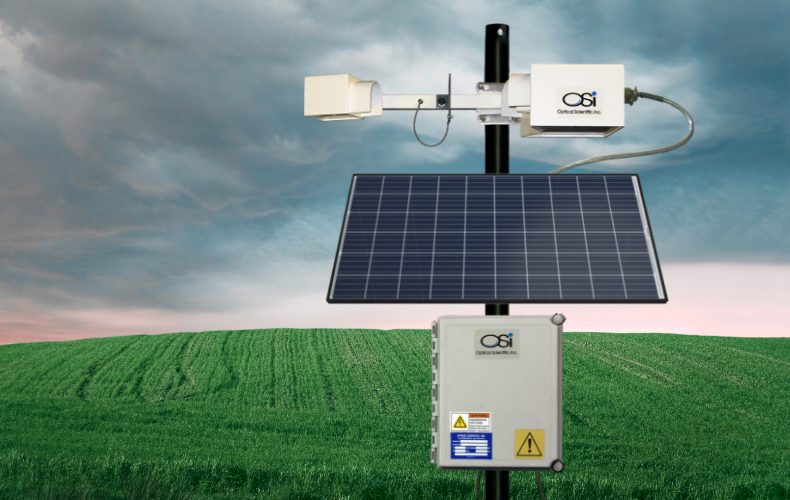
Optical scintillation, engineered in Gaithersburg — fielded worldwide.
Founded in 1985 in the I-270 high-tech corridor near Washington, DC, Optical Scientific designs and manufactures the patented scintillation-based optical sensors behind some of the most demanding environmental and process-monitoring programs on Earth.
Over 40 years our sensors have logged more than 800 million field hours — feeding the algorithms that now ship in every new OSI instrument, and earning the trust of NASA, NOAA, the FAA, EPA and the U.S. military.
- ISO 9001:2015, CE, RoHS, UL, FAA-certified AWOS
- Patented scintillation technology — no moving parts
- U.S.-engineered and manufactured
Four patented optical sensor families
From a single precipitation gauge to an FAA-certified AWOS — every OSI product runs on the same proven scintillation backbone.
Weather Sensors
Patented optical scintillation sensors that measure precipitation, present weather, visibility and snow with NWS-grade accuracy — fielded in every U.S. airport for over 25 years.
- APG-815-DS All Precipitation Gauge
- DSP-WIVIS (OWI-430)
- LP-WIVIS (OWI-650)
Automated Weather Stations
Complete weather observation systems — FAA-certified AWOS for aviation, modular MAWOS for remote sites, and portable HazMet stations for emergency response.
- AWOS-AV FAA Certified
- MAWOS Modular AWOS
- OWI-432 Small Weather Station
Emissions Flow Monitoring
OFS optical flow sensors measure stack gas flow non-intrusively — unaffected by temperature, pressure, density, composition, humidity, moisture or opacity. EPA Method 14, MACT and CFR Part 75 compliant.
- OFS-2000 Optical Flow Sensor
- OFS-2000W for Wet Scrubbers
- OFS-2000F Flare Sensor
Other Sensors
Specialised optical instruments built on the same scintillation platform — long-baseline anemometers measuring path-averaged crosswind and Cₙ² turbulence from 100 m to 10+ km, plus laser level metering for tanks, bins and silos.
- LOA-005 Long-Baseline Anemometer
- LLM-100 Laser Level Meter
- WSS-300-DS Tunnel Wind Speed & Smoke Sensor
Why customers specify OSI sensors
NWS-grade accuracy, refinery-grade durability, research-grade traceability — in instruments designed to run for decades unattended.
Patented scintillation tech
Proprietary forward-scatter optics with no moving parts — the algorithm has 800M+ field hours behind it.
FAA / EPA / NWS proven
FAA-certified AWOS, EPA Method 14 compliant OFS, and the LEDWI sensor at every U.S. airport.
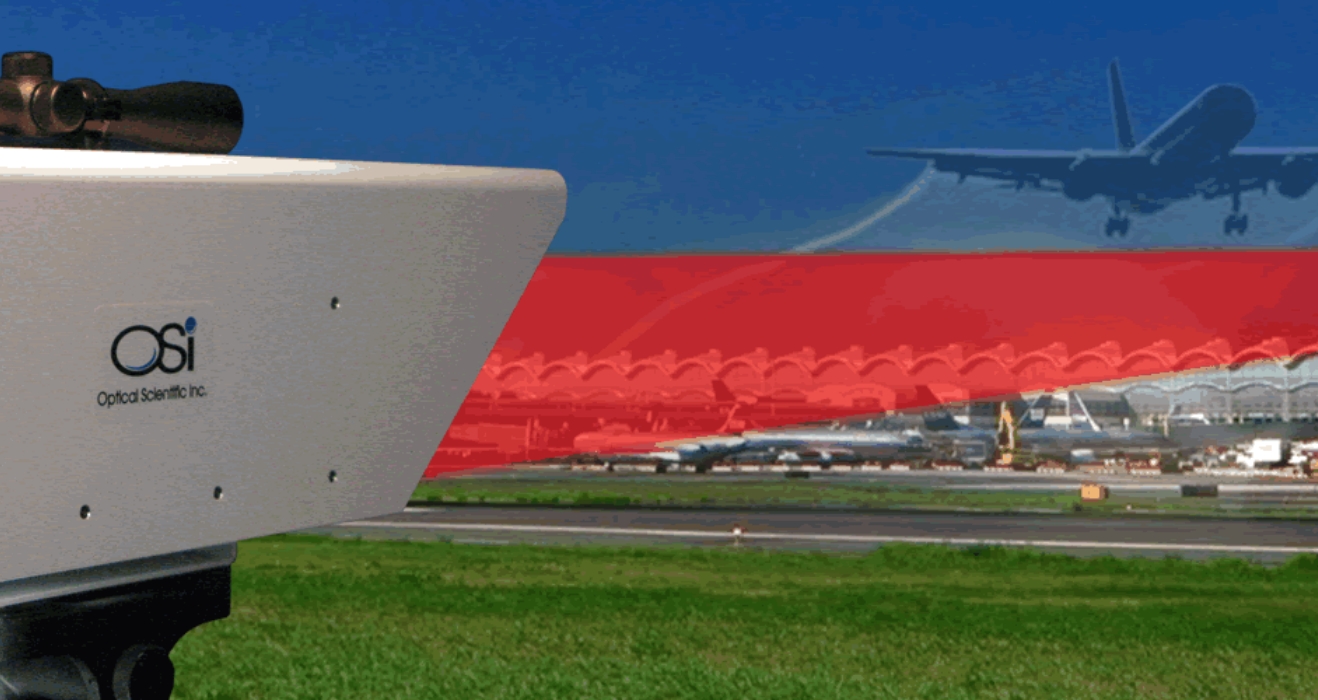
NASVOR — turbulence & tip-vortex sensing for NASA.
The NASVOR system is the OSI Airspace Systems heritage instrument for detecting and measuring atmospheric turbulence and aircraft wake tip vortices. NASA tested it at Langley to characterize wake encounter risk during runway-spacing trials — and the same long-baseline optical anemometer core now ships in the production LOA-005.
- Path-averaged Cₙ² atmospheric turbulence
- Wake vortex detection across runway baselines
- Tested by NASA Airspace Systems Program
Where OSI sensors run today
From every U.S. airport to refineries, smelters, research labs, agrimet networks and Antarctic field stations.
Aviation & Airports
FAA-certified AWOS, present-weather and visibility sensors fielded at every U.S. airport for 25+ years.
Explore applicationHighways & Transportation
Present-weather, visibility and crosswind sensing for highway DOTs, rail operators and tunnel authorities.
Explore applicationPower Plants & Energy
OFS optical flow sensors for stack gas flow plus precipitation and crosswind sensing for solar and wind farms.
Explore applicationRefineries & Petrochemical
OFS flare-stack and process-flow sensing for refineries, petrochemical, SRU and thermal oxidizers.
Explore applicationGovernment & Research
Custom optical sensing programs for NASA, NOAA, EPA, DoE, and the U.S. military.
Explore applicationEnvironmental Monitoring
Ambient air, hydromet, agrimet and stormwater monitoring — optical sensors with 800M+ field hours.
Explore applicationFrom application brief to fielded sensor
Every deployment is engineered — even the off-the-shelf catalog products are matched, calibrated and integration-tested for the site.
Application brief
Gas stream, deployment site, range, accuracy goals, environmental envelope, communications.
Sensor spec
Off-the-shelf where it fits; custom electronics, optics or housings where it doesn't.
Calibration & QC
ISO 9001:2015 calibration, NIST-traceable where required, full factory acceptance test.
Field commissioning
Optional on-site installation, integration test, and operator handover.
Frequently asked questions
Good to KnowOSI sensors measure the natural intensity fluctuations of light propagating through the atmosphere or a gas stream. Raindrops, snowflakes, droplets or turbulent eddies all scatter light in characteristic ways — the OSI patented forward-scatter optics and DSP convert that signal into precipitation type, rate, visibility, gas flow or Cₙ² turbulence with no moving parts.
Yes. Our AWOS-AV is FAA-certified for non-federal aviation weather observation; the OFS optical flow sensor is EPA Method 14, MACT RSR 40 CFR 63.670 and CFR Part 75 compliant; and OSI is ISO 9001:2015, CE, RoHS, UL and EN/IEC 61010 certified.
Standard catalog products typically ship in 5–7 working days from payment confirmation. Custom integration, OEM programs and FAA AWOS deployments are scheduled on the engineering brief — talk to our sales engineers for a real deployment timeline.
Yes — that's what they were designed for. The OWI-650 LP-WIVIS runs at < 3 W typical, the APG-815 has no moving parts and an 80,000-hour MTBF, and MAWOS systems ship with full solar + battery + comms packages for unattended remote deployment.
Customers include NASA (Goddard, Kennedy, Langley), NOAA NWS, FAA, EPA, the U.S. Air Force and U.S. Army, Los Alamos and Sandia National Labs, the Australian Antarctic Division, CSIRO — plus BP, Chevron, ExxonMobil, Shell, Petrobras, Boise Paper, Alcoa, Saint Gobain and many more.

Specify a sensor for your application.
Tell us about the deployment — gas stream, deployment site, accuracy goals — and our engineering team will respond within one business day.
- Engineering response within one business day
- Custom integration and OEM programs welcome
- 40+ years of optical sensing heritage behind every quote