
This guide explains what dew point is, how it differs from relative humidity, what the numbers actually mean for human comfort, how it's measured, and why precise dew point monitoring is non-negotiable in aviation, transportation, and industrial operations.
Key Takeaways
- Dew point is the temperature at which air becomes saturated and water vapor condenses into liquid — it's a direct measure of actual moisture content
- Dew point stays constant as temperature fluctuates, making it a more stable and reliable moisture parameter than relative humidity
- Below 55°F feels dry and comfortable; above 65°F, humidity becomes noticeably oppressive
- Chilled mirror hygrometers and capacitive transmitters measure dew point in lab, industrial, and field environments
- Aviation, transportation, pipeline, and power generation sectors rely on continuous dew point data to prevent equipment failures and protect safety
What Is Dew Point?
According to the American Meteorological Society Glossary, dew point is the temperature to which an air parcel must be cooled — at constant pressure and constant water vapor content — for saturation to occur. At that exact temperature, water vapor condenses into liquid at the same rate it evaporates, creating equilibrium.
When air cools below its dew point, it can no longer hold all the water vapor present. The excess precipitates out: as dew on surfaces at ground level, as fog in the lower atmosphere, or as clouds at altitude.
The Frost Point Distinction
When the dew point temperature falls below 0°C (32°F), water vapor skips the liquid phase entirely and deposits directly as ice crystals. The AMS refers to this as the frost point — a distinction that matters in cold-climate meteorology and in industrial systems where below-freezing process temperatures are common.
Pressure Effects on Dew Point
Air temperature alone doesn't change the dew point. Pressure does. As pressure increases, gas molecules compress and pack more tightly, making it easier for water vapor molecules to collide and condense — which raises the dew point. Decreased pressure has the opposite effect.
NIST research on dew point in compressed gases confirms that dew point, water mole fraction, and pressure must be characterized together — they cannot be treated as independent variables.
Mismatched sample and process pressure can introduce errors of several tens of degrees. In compressed-air systems, natural gas pipelines, or any process where gas is measured under pressure, that margin of error is operationally unacceptable. Always record the pressure basis alongside any dew point measurement.
Dew Point vs. Relative Humidity: Key Differences
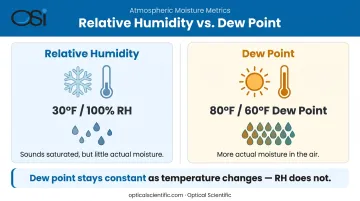
Relative humidity (RH) is a percentage — it tells you how close the air is to full saturation at its current temperature. Dew point is an absolute temperature that tells you how much moisture is actually present, regardless of temperature.
The National Weather Service illustrates this cleanly:
| Scenario | Air Temp | RH | Dew Point |
|---|---|---|---|
| Cold winter morning | 30°F | 100% | 30°F |
| Humid summer afternoon | 80°F | 50% | 60°F |
The winter morning looks more humid on paper — 100% RH sounds saturated. But the summer afternoon has a dew point of 60°F versus 30°F, meaning the actual moisture burden in the air is far greater. Anyone who's experienced both conditions knows which one feels worse.
Why Dew Point Wins for Monitoring
When temperature rises throughout the day with no change in moisture, RH drops — sometimes dramatically. Dew point stays flat. This stability makes dew point the more reliable parameter for:
- Weather forecasting, where operators need moisture trends unaffected by daily temperature swings
- Industrial process control, since set points tied to dew point hold steady as ambient temperature shifts
- Energy management applications that require consistent control targets rather than a moving RH baseline
For any application where moisture control matters — process environments, outdoor monitoring stations, or industrial compliance — dew point gives operators a stable, temperature-independent signal that RH simply can't provide.
The Dew Point Comfort Scale: What the Numbers Mean
The NWS provides a practical comfort reference that anyone monitoring outdoor conditions should know:
| Dew Point Range | How It Feels |
|---|---|
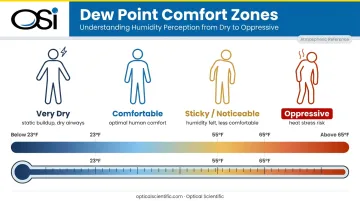
| At or below 55°F (13°C) | Dry and comfortable |
| 55°F – 65°F (13°C – 18°C) | Sticky; noticeable on humid evenings |
| At or above 65°F (18°C) | Oppressive; outdoor activity becomes difficult |
Why High Dew Point Drains You
The body cools itself through sweat evaporation. When the air already holds high moisture levels, that evaporation slows — sometimes nearly stops. The result: core temperature climbs, heat stress risk increases, and physical performance deteriorates. OSHA identifies combined heat and humidity as a primary driver of occupational heat illness.
A 70°F dew point falls squarely within the NWS "oppressive" category and represents conditions that most people find genuinely difficult to work in outdoors. NWS Tampa Bay documented a station record of 86°F dew point on August 6, 2000. In 2024, the same area recorded 7 consecutive days with dew points at or above 75°F from August 5–11 — conditions that pushed heat index readings well into the danger zone for outdoor workers.
Low Dew Point Hazards
High dew points aren't the only concern. Dew points below roughly 23°F (-5°C) create an entirely different set of problems:
- Dry air irritates mucous membranes and airways
- Static electricity buildup becomes a hazard in electronic assembly and industrial environments
- Wood, seals, and other materials dry out and crack
How Is Dew Point Measured?
The general category of instruments used for dew point measurement is the hygrometer. Different variants suit different accuracy requirements, operating environments, and budgets.
Chilled Mirror Hygrometers
This is the reference-grade method. A polished metal mirror is cooled by a thermoelectric device while air flows over it. When the mirror surface reaches the dew point temperature, condensation forms and is detected optically. The mirror temperature at condensation onset is the measured dew point.
The NIST humidity metrology program uses a primary-standard Hybrid Humidity Generator covering -90°C frost point to +85°C dew point for calibration traceability. Lab-grade chilled mirror instruments such as the MBW 373 achieve measurement uncertainty of ±0.1°C, making them the standard against which other sensor types are validated.
Chilled mirror hygrometers are used in:
- Primary calibration laboratories
- High-accuracy atmospheric research
- Reference measurements for industrial quality assurance
Electronic Dew Point Transmitters
Electronic or capacitive transmitters use a sensor whose electrical properties — capacitance or resistance — shift with moisture absorption. They're compact, rugged, and cost-effective for continuous monitoring.
Typical accuracy for industrial electronic transmitters is ±2°C (per the Vaisala DMT143 specification). That's sufficient for most industrial and HVAC applications, where the goal is trend monitoring and alarm triggering rather than primary calibration.
Common applications include:
- Compressed-air quality monitoring (per ISO 8573 purity classes)
- Industrial dryer performance verification
- Natural gas pipeline moisture monitoring
- Outdoor weather stations
Automated Weather Observation Systems (AWOS)
Point-measurement instruments cover single-parameter monitoring. Integrated AWOS systems take a different approach: they combine dew point sensors with temperature, wind, visibility, and precipitation sensors to generate continuous, real-time atmospheric reports from a single installation.
ICAO Annex 3 mandates that air temperature and dew point temperature appear in METAR and SPECI reports. The NWS ASOS network treats both as standard, always-present observation elements. OSI's FAA-certified AWOS-AV systems deliver this type of multi-parameter atmospheric monitoring for aviation and transportation safety operations — providing the integrated data packages that pilots, air traffic controllers, and airport operations teams rely on.

Best Practices for Any Dew Point Installation
Instrument selection matters, but installation and maintenance practices determine whether the data you get is actually trustworthy:
- Match the measurement range to the application — industrial compressed-air systems require sensors rated for very low dew points (down to -70°C or lower per ISO 8573-1 Class 1)
- Account for pressure — always record whether the measurement is at process pressure or atmospheric pressure, and apply corrections when needed
- Ensure unrestricted airflow — avoid dead-end pipe stubs or enclosed cavities that create stagnant air pockets
- Follow calibration schedules — even high-quality sensors drift over time; periodic NIST-traceable calibration maintains measurement integrity
Why Dew Point Monitoring Matters: From Weather to Industry
Aviation and Transportation Safety
In aviation, dew point is a required observation, not a comfort metric. Meteorologists use it alongside temperature to calculate cloud base height, predict fog formation windows, and assess carburetor icing risk. The NTSB reported that carburetor icing caused or contributed to approximately 250 general aviation accidents between 2000 and 2011, averaging two fatal accidents per year.
According to the FAA, weather caused 74.26% of all system-impacting delays greater than 15 minutes over a six-year study period — making atmospheric monitoring a core operational requirement, not a backup capability.
For surface transportation, dew point combined with road surface temperature data tells highway maintenance crews when frost or black ice is about to form — enabling proactive anti-icing treatments rather than reactive emergency response. State DOTs including Maryland, Ohio, Wyoming, and several others rely on road weather information systems (RWIS) to manage these conditions.
Industrial and Energy Sector Applications
Across natural gas pipelines, refineries, and power plants, excess moisture isn't a nuisance — it's a failure mode. Uncontrolled water vapor can cause:
- Ice-like hydrate plugs that block gas flow in pipelines
- Accelerated metal corrosion in process equipment
- Moisture contamination that disrupts refining and chemical reactions
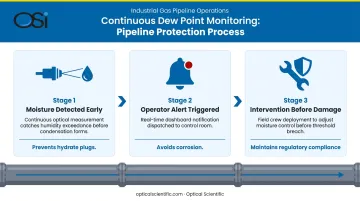
Pipeline-quality gas is typically dried to reduce water dew point below the lowest expected operating temperature. Continuous dew point monitoring allows operators to:
- Detect moisture incursion before it causes equipment damage
- Meet EPA and pipeline quality standards
- Avoid unplanned shutdowns and costly repairs
EPA 40 CFR Part 75, which governs continuous emissions monitoring at power plants, includes moisture monitoring system requirements as part of the compliance framework. OSI's optical environmental sensors are deployed at power plants and refineries operated by companies including Chevron, ExxonMobil, Shell, and Duke Energy, where integrated atmospheric and process monitoring supports both safety and regulatory compliance.
Additional Sectors
Dew point control matters across several other industries:
- Pharmaceutical manufacturing — 21 CFR 211.46 requires adequate environmental control including humidity in drug production areas
- Food processing — 21 CFR Part 117 addresses condensate control to prevent contamination in food facilities
- Semiconductor and electronics — low humidity promotes static electricity that can damage components; cleanroom humidity management is a standard ESD control measure
- Climate and weather research — NOAA and NWS surface observation networks, including ASOS stations, collect continuous dew point data as part of the national climate record
Frequently Asked Questions
What does a 70°F dew point mean?
A 70°F dew point sits firmly in the NWS "oppressive" category. Sweat evaporates poorly at this moisture level, making heat stress risk significantly elevated. Conditions this extreme are most common in tropical climates or during severe summer heat events across the central and eastern United States.
How is dew point measured?
Dew point is measured with a hygrometer — most often a chilled mirror device for high-accuracy laboratory measurement or an electronic capacitive transmitter for industrial continuous monitoring. Automated weather stations typically integrate dew point sensors alongside temperature and pressure instruments for real-time reporting.
What's worse, humidity or dew point?
Dew point is the more meaningful indicator of actual moisture discomfort. Relative humidity can read 100% on a cold, comfortable winter morning; that same 100% RH at 90°F means you're already soaked in sweat with nowhere for it to go. Because dew point doesn't shift with temperature, it gives a consistent read on moisture burden regardless of time of day.
What is a comfortable dew point range?
Dew points at or below 55°F (13°C) feel dry and comfortable to most people, while the 55–65°F range starts to feel sticky, especially in the evening. At 65°F and above, conditions turn muggy to oppressive — prolonged outdoor activity becomes genuinely taxing.
Can dew point ever be higher than air temperature?
No. By definition, the dew point cannot exceed the current air temperature. If it did, condensation would already be occurring and the air would be at 100% relative humidity. The dew point equals the air temperature only at that saturation point — when RH reaches exactly 100%.