Introduction
Get the conversion wrong — wrong lighting category, wrong time of day, or using it when it's prohibited — and the approach decision rests on a figure that doesn't reflect actual operating conditions.
When an aerodrome lacks functioning RVR equipment, pilots and operators can't simply plug raw meteorological visibility into approach planning and call it done. A standardized conversion process is required — one that produces a Converted Meteorological Visibility (CMV) value that can legally substitute for RVR in approach and landing minima assessments.
This guide covers how CMV is derived, what variables control the output, and exactly when the conversion is off the table.
Key Takeaways
- CMV = reported meteorological visibility × a regulatory conversion factor — used only when RVR is not directly reported
- The conversion factor varies by time of day and runway lighting type
- Three hard prohibitions apply: active RVR reporting, takeoff minima, and required RVR below 800 m
- Met visibility and RVR are different measurements — CMV is an approved regulatory bridge, not scientific equivalence
What Are CMV and RVR in Aviation?
Runway Visual Range (RVR)
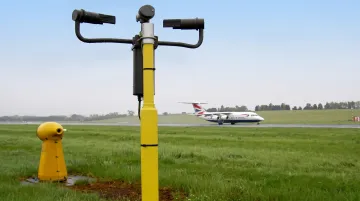
RVR is an instrumentally derived value representing the distance a pilot on the runway centerline can see runway surface markings, delineating lights, or centerline-identifying lights. It's measured by transmissometers or forward-scatter sensors positioned at specific runway points:
- Touchdown zone — required for CAT I operations
- Midpoint — added for CAT II
- Rollout/stop-end — added for CAT III
RVR is reported in meters (EASA/ICAO) or feet (FAA), and it accounts for runway lighting intensity and background luminance — meaning two runways with identical atmospheric conditions but different lighting systems will produce different RVR readings.
Converted Meteorological Visibility (CMV)
Per ICAO Doc 9365 (Manual of All-Weather Operations, 5th Edition, 2024), CMV is defined as "a value (equivalent to an RVR) which is derived from the reported meteorological visibility." It's a calculated approximation — a regulatory substitute for RVR when direct measurement is unavailable.
The Fundamental Measurement Difference
That distinction — "derived from" rather than "equivalent to" — matters operationally. Meteorological visibility and RVR are not the same thing reported differently.
Per the ICAO Aeronautical Information Reference Model, meteorological visibility is the greater of:
- The greatest distance at which a black object of suitable dimensions can be seen against a bright background
- The greatest distance at which lights near 1,000 candelas can be seen against an unlit background
This is a broad, omnidirectional horizon assessment. RVR, by contrast, is a precise, runway-specific measurement that factors in lighting contrast and background luminance directly relevant to a pilot on approach.
Applying raw met visibility as a direct RVR substitute — without conversion — produces systematically incorrect results, particularly at night or under low-intensity lighting.
Why CMV Exists
Many aerodromes — smaller airports, heliports, private airfields — operate without installed RVR sensor equipment. CMV provides the regulatory mechanism for IFR operations to continue at those locations using an approved conversion formula applied to reported met visibility. Without it, any aerodrome lacking sensor infrastructure would face an effective operational halt under low-visibility conditions.
How the Meteorological Visibility to RVR/CMV Conversion Works
The Core Formula
CMV = Reported Meteorological Visibility × Conversion Factor
The factor is not fixed. Before applying it, two parameters must be confirmed:
- Whether conditions are classified as day or night
- Which lighting category is currently in operation on the runway
The Regulatory Conversion Table
The following table is sourced from EASA AMC8 NCC.OP.110 (Issue 1, Amendment 16) and confirmed in ICAO Doc 9365:
| Lighting Elements in Operation | Day Factor | Night Factor |
|---|---|---|
| HI approach and runway lights | ×1.5 | ×2.0 |
| Any other type of light installation | ×1.0 | ×1.5 |
| No lights | ×1.0 | Not applicable |
These multipliers are not arbitrary. They reflect the degree of visual contrast enhancement that different lighting systems provide — and the degraded visual environment at night, where pilots rely far more heavily on lighting contrast against a dark background.
Worked Example
Reported met visibility: 600 m, daytime, HI approach and runway lights in operation:
CMV = 600 × 1.5 = 900 m
Same 600 m met visibility, same lighting, but at night:
CMV = 600 × 2.0 = 1,200 m
The raw visibility hasn't changed. What's changed is the regulatory recognition that night conditions degrade the effective pilot sightline — so the CMV is higher, reflecting a more conservative operational boundary.
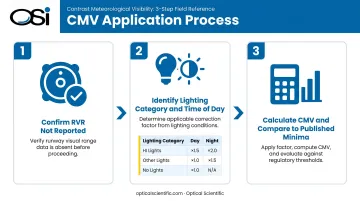
Applying CMV in Three Steps
Step 1: Confirm RVR is not reported Check whether the aerodrome is actively reporting an RVR value for the runway in use. If it is — even a value below the sensor's maximum range — stop. The conversion does not apply and reported RVR must be used directly.
Step 2: Identify lighting category and time of day Determine which of the three lighting rows applies based on what's actually in operation — not what's installed. ATC may adjust runway light intensity during the approach; if they switch from HI to a lower setting, the applicable row in the table changes. Confirm day/night classification per applicable regulations.
Step 3: Calculate CMV and compare against published minima Multiply the reported met visibility by the appropriate factor. The resulting CMV is then compared directly to the RVR/CMV minimum published on the approach plate or operations manual. If CMV meets or exceeds the published minimum, the approach may proceed.
The "RVR Above Maximum Value" Edge Case
If an aerodrome reports RVR as exceeding its sensor ceiling — for example, "RVR more than 1,500 m" — this is not treated as a reported RVR value for prohibition purposes. The pilot may still apply the CMV conversion in this situation. This provision prevents the prohibition from being triggered by a measurement ceiling rather than an actual RVR reading.
The Importance of Clean Input Data
CMV accuracy is entirely dependent on the quality of the meteorological visibility report feeding into the formula. Delayed reports, human observer limitations, or sensors with calibration drift can all introduce error into the calculation before the multiplication factor is even applied.
That accuracy starts with the input data. OSI's FAA-certified AWOS-AV systems generate continuous METAR-format visibility reports with an MTBF exceeding 80,000 hours — the kind of reliable, real-time measurement that sound CMV calculations require.
When the CMV Conversion Cannot Be Used
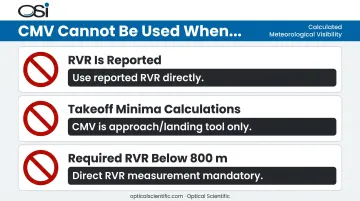
Three explicit regulatory prohibitions apply, per EASA AMC8 NCC.OP.110 and ICAO Doc 9365.
The Three Hard Prohibitions
| Condition | Rule |
|---|---|
| RVR is reported | Use reported RVR directly — CMV substitution is not permitted regardless of outcome |
| Takeoff minima calculations | CMV is an approach/landing tool only; separate regulations govern takeoff |
| Required RVR minimum below 800 m | CMV is prohibited; direct RVR measurement is mandatory |
Why the 800 m Threshold Exists
Below 800 m, the approximation error built into deriving CMV from a broad omnidirectional measurement becomes operationally significant. At these margins, small derivation errors can mean the difference between a legal and an illegal approach.
The affected categories — CAT II (RVR ≥ 300 m), CAT IIIA (≥ 200 m), and CAT IIIB (75–200 m) — all fall below the threshold. The 800 m barrier effectively blocks CMV use for all CAT II/III operations in the EASA framework.
What to Do When Conversion Is Prohibited
When any of the three prohibition conditions apply and the required data is unavailable or inadequate, the approach may not be commenced. This is a deliberate safety boundary with no regulatory workaround.
When direct RVR is required, the practical response is straightforward:
- No RVR available: Do not commence the approach
- RVR below minimums: The approach is not authorized regardless of MET visibility
- Takeoff operations: Apply the applicable takeoff minima framework separately
Key Factors Affecting Conversion Accuracy and Common Misconceptions
Factors That Affect Conversion Accuracy
Source report quality is the primary variable. Prevailing meteorological visibility is defined as the greatest visibility equaled or exceeded throughout at least half the horizon circle — a broad, averaged measurement. It may not reflect conditions at the specific runway threshold. Human observer reports can differ from automated sensor outputs, and reports may lag real-time conditions.
Research published in the Journal of Atmospheric and Oceanic Technology found that RVR prediction from visibility involves parameterization that depends on runway light intensity and background luminance, with correlation to observations at r = 0.8. The same study found that automated forward-scatter sensors can show bias of roughly 20% underestimation for visibility below 5 km.
Lighting system status in operation is the second critical variable. The conversion table applies to what's currently active, not what's installed. Key pitfalls:
- ATC adjusting runway light intensity mid-approach shifts the applicable table row
- "HI lights installed" ≠ "HI lights in operation"
- Confusing installed capability with active status leads to applying the wrong multiplier
Common Misconceptions
CMV and RVR are not the same measurement. RVR is a direct instrument measurement at runway surface level, accounting for lighting and luminance. CMV is a derived approximation from omnidirectional horizon observation. They are legally equivalent substitutes in specific regulatory circumstances — not scientifically identical measurements.
A higher CMV does not mean better conditions. The night multiplier (×2.0 for HI lights) produces a larger CMV from the same raw visibility than the daytime multiplier (×1.5).
Pilots who interpret the multiplied output as "actual visibility" rather than a regulated conservative substitute misapply the entire framework. The higher number reflects a safety buffer, not improved atmospheric conditions.
Frequently Asked Questions
What is the difference between RVR and vis?
Meteorological visibility (vis) is a broad, omnidirectional measurement of how far a standard object can be seen across the horizon. RVR is a runway-specific, instrumentally derived value indicating how far a pilot can see runway markings or lights from the approach centerline. RVR accounts for lighting intensity and background luminance; met visibility does not.
What is the definition of meteorological visibility?
Per ICAO, meteorological visibility is the greater of: the farthest distance at which a black object of suitable dimensions is visible against a bright background (daytime), or the farthest distance at which a ~1,000-candela light source is visible against an unlit background (nighttime). Both are assessed with the unaided eye.
When can CMV be used instead of RVR?
CMV may be used when RVR is not directly reported by the aerodrome, the applicable RVR minimum is 800 m or above, and the operation is an approach or landing (not a takeoff). When those conditions are met, reported met visibility is multiplied by the appropriate regulatory factor based on lighting type and time of day.
What is the difference between LVO and LVP?
Low Visibility Operations (LVO) is the broad term for flight operations conducted below standard visibility minima. Low Visibility Procedures (LVP) are the specific ground and ATC procedures activated at an aerodrome to protect ILS critical areas and manage traffic during those conditions. LVP must be in force before CAT II/III approaches can be conducted.
What is the "70/50 rule"?
No confirmed EASA, UK CAA, or FAA rule uses this exact name. The closest verified framework is Canadian: Transport Canada permits commercial operators to approach at 75% of charted visibility, with approvals allowing as low as 50%. Treat "70/50" as jurisdiction-specific shorthand and verify the applicable regulation for your operating environment.
Why are different multipliers used for daytime versus nighttime?
At night, pilots rely on runway lighting contrast against a dark background rather than ambient light, which reduces effective sightline for any given raw met visibility value. The higher nighttime multiplier (×2.0 vs. ×1.5 for HI lights) compensates for this reduced visual perception, producing a CMV value that reflects actual operational limits.