
Introduction
A farm weather station sitting dark during a frost advisory isn't a weather problem — it's a power problem. Station value depends entirely on one thing: whether sensors collect data reliably, around the clock, in locations with no electrical infrastructure.
That distinction rarely gets discussed. Weather monitoring gets the attention. Sensor power architecture gets treated as an afterthought, until a station fails at a critical moment and a crop decision goes wrong without the data to back it up.
According to USDA ERS research, precision agriculture technologies reduce input costs by $2 to $22 per acre depending on the application. That return only materializes when the monitoring systems stay online. Low-power sensors are what make continuous operation possible in remote, off-grid farm environments — and this article covers the specific operational advantages they deliver in real deployments.
Key Takeaways
- Deploy weather stations anywhere on a property — no electrical infrastructure required
- Gapless data collection holds through storms, overcast skies, and overnight periods when risk is highest
- Lower power hardware costs make it practical to scale sensors across multiple field locations
- Optical no-moving-parts designs draw minimal power and deliver lower maintenance and failure rates
- An 80,000+ hour MTBF means properly specified sensors run for years without intervention
What Are Low-Power Sensors in Farm Weather Stations?
Low-power sensors are electronic sensors designed to measure weather variables — temperature, humidity, precipitation, wind speed, soil moisture — while drawing minimal electrical current. In agricultural wireless sensor networks, this means operating in the tens of milliwatts range rather than pulling multiple watts continuously.
Peer-reviewed research on agricultural sensor networks confirms that practical field-deployed nodes are designed around energy-constrained architectures, duty cycling, and reduced transmit power — not a single universal watt threshold, but a consistent design philosophy of drawing only what's necessary.
These sensors are deployed as standalone weather stations across a range of agricultural environments, typically kilometers from the nearest grid connection and powered by small solar panels or battery packs:
- Crop fields and row-crop operations
- Orchards and tree fruit operations
- Vineyards and specialty agriculture
- Pastures and rangeland
Low-power design is what makes distributed, autonomous weather monitoring across large agricultural land areas physically and economically possible — not a constraint, but the core engineering requirement.
Key Benefits of Low-Power Sensors in Farm Weather Stations
These advantages aren't abstract — they directly affect what farmers can monitor, when they can monitor it, and what it costs to do so consistently.
Energy Independence and Flexible Deployment
Low-power sensors can run entirely on small solar panels and battery backups, eliminating the need for grid power or costly electrical runs across farm property.
A sensor node drawing only a few milliwatts can sustain operation through multiple consecutive overcast days and overnight on a modestly sized solar-charged battery pack. Published benchmarks confirm this: a self-powered environmental IoT sensor node averaging 4.9 mW operated continuously through 12 hours of darkness using only a 310 mW solar panel and a 50-farad supercapacitor. A full agricultural climate station can run on a 10-watt solar panel with a 6,000 mAh primary battery — a footprint that's practical anywhere on a farm.
Why this matters for farm deployments specifically:
- Most high-value monitoring locations — field edges, frost-prone low spots, orchard rows — sit nowhere near an electrical outlet
- Without low-power sensors, these microclimates go unmonitored by default
- WSU research found commercial apple orchards run 1.9 to 4.4°C cooler and 9.2% to 27.5% more humid than nearby open-field conditions — differences large enough to change frost protection decisions entirely
This advantage is most critical in large-scale row crop operations, hillside vineyards, and remote pasture environments where running power lines is cost-prohibitive and weather variability across the property is significant.
OSI's APG-815-DS All Precipitation Gauge is built for exactly these deployments. It operates on nominal 12 VDC at a maximum 400 mA draw, includes Adaptive Heater Technology (AHT) that only energizes lens heaters when conditions require it, and pairs directly with solar power kits and cellular modems for genuinely grid-independent remote installations.
Continuous, Uninterrupted Data Collection
Low-power sensors maintain operation through overcast days, overnight hours, and multi-day storm systems: precisely the conditions when a power-hungry sensor on an undersized solar system may brown out or shut down entirely.
That's not a minor operational detail. Weather threats driving the most critical farm decisions — frost, disease pressure, irrigation triggers — arrive in narrow time windows. A few hours of data loss can mean the difference between a protected crop and a failed one.
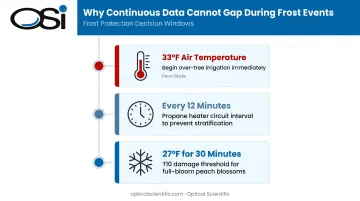
Consider the timing constraints involved in frost protection alone:
- Penn State Extension notes that over-tree irrigation systems must begin when air temperature drops to 33°F
- Propane heater routes must complete a circuit every 12 minutes to prevent air stratification
- USU Extension reports peach blossoms at full bloom face meaningful crop damage at 27°F for just 30 minutes (T10 threshold)
Miss a two-hour window of temperature data during a frost night because the station powered down, and the entire protection response fails.
Disease pressure monitoring carries the same dependency. Cornell Cooperative Extension's disease models for vineyards require continuous inputs of temperature, precipitation, relative humidity, and leaf wetness.
A peer-reviewed review of grapevine disease models confirms that data gaps and inconsistent sensor estimation rank among the most common limitations in field model accuracy. Not algorithm problems — data completeness problems.
KPIs directly affected by data continuity:
- Alert reliability rate for frost and disease events
- Irrigation scheduling accuracy
- Completeness of historical microclimate datasets for trend analysis
OSI's OWI-650 LP-WIVIS (Low Power Weather Identifier) is designed specifically for battery and solar-powered deployments. It can operate in intermittent mode — powering up for one minute per cycle, reporting present weather and visibility, then powering back down — with heaters independently controlled and active only when detection algorithms identify dew or frost on the lenses.
Lower Total Cost of Ownership and Scalability
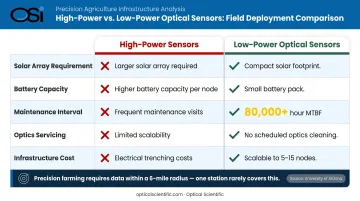
Lower power draw reduces hardware costs in two ways: smaller solar panels and batteries at each node, and no electrical trenching or infrastructure costs across farm property. Both are significant.
But the more consequential cost advantage is what low power enables at scale. Fewer watts per node means fewer maintenance visits — and that's where the lifecycle economics really shift.
Conventional mechanical sensors — tipping-bucket rain gauges, cup anemometers — require scheduled servicing. Cornell NEWA's maintenance guide recommends cleaning tipping-bucket gauges 1 to 2 times per year, calibrating sensors every 2 years, and replacing radiation diffusers as they yellow.
IFAS/AgroClimate field guidance notes anemometer bearing failure as a documented failure mode requiring quarterly checks. Those service trips add up fast across a multi-node farm network.
Optical, solid-state sensor designs with no moving parts eliminate that maintenance burden. OSI's sensors carry an MTBF in excess of 80,000 hours — approximately 9.1 years of continuous operation before an expected failure event. Field-based statistics exceed even that figure.
The APG-815-DS requires no scheduled cleaning of optics, is insensitive to dirt buildup, and needs no antifreeze chemicals or high-power heaters for snow measurement. Field calibration is typically needed only every two years, and built-in self-diagnostics report performance status every minute, flagging any issues without a site visit.
Where scalability pays off:
| Configuration | Cost Driver |
|---|---|
| High-power sensors | Larger solar arrays, more battery capacity, more frequent maintenance visits per node |
| Low-power optical sensors | Smaller hardware footprint, fewer maintenance visits, lower per-node lifecycle cost |
When each additional monitoring node costs significantly less to power and maintain, deploying 5, 10, or 15 stations across a farm becomes economically viable. University of Arizona Extension data makes the precision agriculture case clearly: large-scale weather patterns are only reliable within a 60-mile radius, while precision farming applications need data from within a 6-mile radius of the field. A single station rarely covers that requirement across a topographically varied property.
What Happens When Farm Weather Stations Lack Low-Power Sensors
The failure mode is predictable. A weather station with high power consumption goes offline during a stretch of overcast weather — exactly when storm systems or frost events are approaching — and the farmer falls back on regional forecasts.
Regional forecasts are not field-accurate. The WSU orchard research cited above shows temperature deviations of nearly 4.5°C between open-field readings and actual in-orchard conditions. A regional forecast showing 34°F may correspond to 29°F in a frost pocket at the orchard edge. That difference is significant when the damage threshold for full-bloom stone fruit is 27°F for 30 minutes.
The cascading consequences of data gaps:
- Missed frost warnings → unprotected crops, no time to start irrigation or activate heaters
- Incomplete humidity data → disease pressure models produce unreliable outputs; spray timing windows missed
- Intermittent soil moisture readings → over-irrigation or under-irrigation, wasted inputs
These data gaps compound a deeper structural problem. Farms running high-power sensor systems often cap deployment at one or two stations because infrastructure cost climbs with every added node.
A single station cannot capture microclimate variation across a 200-acre farm with topographic relief. The result is sparse data driving generalized decisions — exactly what precision agriculture is meant to eliminate.
How to Get the Most Value from Low-Power Farm Weather Sensors
Low-power sensors perform best when deployed thoughtfully, not just minimally.
Deployment planning:
- Base station placement on crop type, frost risk zones, and irrigation management boundaries
- Reference Cornell NEWA's placement guidance: position stations in open areas, at least twice the height of nearby obstructions, to minimize interference with wind and temperature readings
- In orchards and vineyards, plan for the microclimate variation that a single perimeter station will miss
Data integration:
- Integrate sensor outputs with platforms that generate frost warnings, disease pressure alerts, and irrigation triggers automatically — raw data only has value when it drives decisions
- Sensors that update every minute and support multiple wired and wireless communication protocols can feed directly into farm management software without additional hardware
Sensor selection criteria:
- Verify MTBF ratings against field-proven figures, not theoretical calculations — OSI's sensors exceed 80,000 hours MTBF across real-world deployments
- Prioritize built-in self-diagnostics that eliminate the need for scheduled maintenance visits
- Confirm the operating temperature range covers your region's extremes, from frost-prone northern orchards to high-temperature irrigated row crops
- For outdoor field durability, check enclosure ratings and confirm the sensor design is insensitive to dust, humidity, and partial optical obscuration
Conclusion
Low-power sensors are the foundational requirement for farm weather monitoring that works as intended — deployable anywhere, continuously reliable, and economically scalable without electrical infrastructure.
These three advantages compound over time. Energy independence means placing monitoring where it actually matters, not where power happens to exist. Data continuity keeps the alerts and models built on that data accurate when conditions are at their most dangerous. Lower total cost of ownership means adding monitoring nodes stays practical as the farm's precision agriculture program grows.
Each of those advantages feeds the others. The longer a low-power sensor network operates without interruption, the richer the localized dataset becomes and the more accurate the decision support it generates. Choosing the right sensor architecture at the outset is what makes that accumulation possible.
Frequently Asked Questions
Which sensors are most important for a farm weather station?
The core sensor types are temperature, humidity, precipitation, wind speed/direction, and soil moisture. Priority depends on your operation's risk profile — frost-prone orchards need highly accurate temperature and dew point sensors, while variable-rainfall row crop farms should prioritize precipitation and soil moisture measurement.
What are the benefits of low-power sensors in a farm weather station?
Low-power sensors deliver four practical advantages for farm weather monitoring:
- Enable off-grid deployment without running electrical infrastructure to each node
- Sustain uninterrupted data collection during cloudy or stormy periods
- Reduce total cost of ownership compared to high-consumption alternatives
- Make scaling to multiple field locations economically practical
Can low-power farm weather sensors run entirely on solar power?
Yes. Most low-power sensor systems are designed to operate on small solar panels paired with a battery buffer sized to sustain operation overnight and through several consecutive overcast days, making them genuinely grid-independent in most agricultural environments.
How does low power consumption affect data reliability in farm weather stations?
Lower power draw allows the station to keep running on limited solar charging during cloudy or short-day periods. This prevents the data dropouts that hit high-consumption systems hardest — typically during the very weather events you most need to capture.
What is the typical lifespan or maintenance requirement for low-power agricultural sensors?
Well-designed low-power sensors with no moving parts — particularly optical and solid-state designs — can operate for years with minimal or no scheduled maintenance. Key specs to evaluate are MTBF ratings and enclosure durability; OSI's agricultural sensors carry an MTBF exceeding 80,000 hours with no scheduled optics cleaning required.
How many weather stations does a farm need for accurate microclimate monitoring?
University of Arizona Extension research found that precision farming requires weather data from within a 6-mile radius of the field — and microclimate variation within a single farm can be significant. Low-power sensors make multi-node networks economically viable where high-power systems would not.