Introduction
Industries that depend on continuous measurement — power generation, emissions monitoring, aviation, oil and gas, transportation infrastructure — are operating under tighter constraints than ever. Regulatory requirements are stricter, safety expectations are higher, and maintenance windows keep shrinking. Unplanned downtime carries real financial consequences.
Instrument selection sits at the center of all these pressures. The choice between intrusive and non-intrusive measurement isn't just a technical preference — it directly shapes maintenance costs, personnel safety exposure, data quality, and long-term compliance posture.
Non-intrusive measurement instrumentation gets mentioned frequently in product literature, but rarely explained in terms of what it delivers day-to-day. This article covers exactly that: the specific, measurable operational advantages, and when each one matters most.
Key Takeaways
- Non-intrusive instruments measure process variables — flow, precipitation, visibility, temperature — without penetrating, contacting, or disrupting the process medium
- Primary advantages: lower maintenance burden, reduced safety exposure, and higher data reliability through continuous monitoring
- No moving parts, no fouling, no calibration drift from mechanical wear
- Benefits compound at remote sites, in hazardous environments, and under strict compliance programs
- Value comes from acting on data continuously — not just collecting and archiving it
What Is Non-Intrusive Measurement Instrumentation?
Non-intrusive measurement instrumentation captures process variables — air and gas flow velocity, precipitation type and rate, atmospheric visibility, crosswind speed, stack emissions — without physically entering, contacting, or disrupting the medium being measured. Because the sensing element operates at or beyond the process boundary, the process itself stays undisturbed throughout continuous operation.
Where It's Applied
Non-intrusive measurement shows up across a wide range of industries and applications:
- Industrial emissions monitoring — stack gas flow measurement at power plants and refineries
- Aviation and airports — visibility, precipitation, and wind data for FAA-certified AWOS systems
- Highway and transportation — road weather and visibility sensing across DOT networks
- Environmental compliance — continuous data supporting EPA regulatory programs
- Marine and remote deployments — precipitation and weather monitoring on data buoys and research vessels
- Research installations — polar stations, national laboratories, and government monitoring networks
Avoiding a pipe penetration is one benefit, but the deeper value is accurate, continuous data with minimal operational burden — from initial installation through the full service life of the instrument.
Key Advantages of Non-Intrusive Measurement Instrumentation
The advantages below are grounded in operational outcomes organizations actually track: maintenance cost, uptime, safety exposure, data quality, and regulatory compliance. These aren't abstract claims — they compound over time and become most visible at scale or over a multi-year deployment horizon.
Advantage 1: Dramatically Lower Maintenance Burden and Near-Zero Downtime
Non-intrusive instruments have no moving parts, no physical contact with the process medium, and no exposure to the mechanical stress, fouling, or corrosion that degrades intrusive sensors. Scheduled maintenance becomes minimal — or disappears entirely.
Intrusive instruments like pitot tubes, sampling probes, and mechanical flow meters require regular cleaning, recalibration, and component replacement as they wear. A mechanical tipping bucket rain gauge, for example, is prone to clogging from insects, debris, and ice — requiring physical intervention to restore accuracy.
An optical sensor with no moving parts and automatic gain control to compensate for optical contamination simply continues operating.
Unplanned industrial downtime costs manufacturers an estimated $50 billion annually, and a significant share of that cost traces back to instrument failures, missed calibration windows, and measurement gaps that allow process deviations to go undetected.
Non-intrusive designs eliminate these variables. OSI's optical sensors — including the OFS series for stack gas flow and the OWI series for weather identification — are built with:
- No moving parts
- All-digital DSP-based electronics with no temperature-sensitive analog components
- Built-in continuous self-diagnostics that update every 60 seconds
- Automatic gain control to compensate for signal degradation without manual intervention
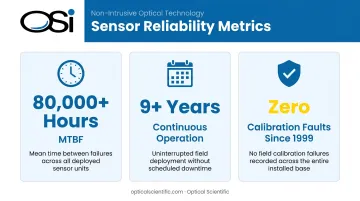
The result is an MTBF exceeding 80,000 hours — more than nine years of continuous operation between failure events. OFS sensors have logged continuous operation without a single calibration fault since their 1999 deployment.
When this advantage has the greatest impact:
- Remote or difficult-to-access sites (offshore platforms, polar research stations, highway installations)
- 24/7 operations where any shutdown carries significant production cost
- Harsh environments that accelerate mechanical wear — high dust, extreme temperatures, corrosive atmospheres
Advantage 2: Enhanced Safety in Hazardous and Demanding Environments
Non-intrusive instruments don't require process penetration, containment breach, or direct contact with the process medium. That means maintenance personnel aren't exposed to high-pressure, high-temperature, corrosive, or toxic conditions during installation, calibration, or servicing.
With intrusive instruments, technicians must break containment or enter hazardous zones to install, calibrate, and replace sensors. Hot-tap procedures, confined space entry, and pressure vessel work each carry documented safety risks — along with significant regulatory overhead.
Confined space incidents remain among the most serious in industrial environments. According to NIOSH data, confined space fatalities occur at a disproportionately high rate relative to total hours worked, and many are directly associated with maintenance activities in processing facilities.
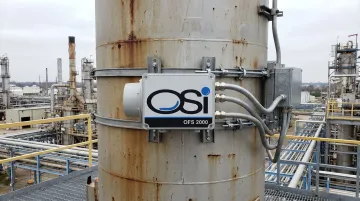
Non-intrusive sensors mounted externally or at a distance allow the process to remain sealed and pressurized throughout the instrument's service life. OSI's OFS-2000, for instance, provides true cross-stack flow measurement with no direct contact with the gas stream — eliminating the need for technicians to access stack internals for calibration or replacement.
For applications where installation on live processes is required, hot-tap procedures using gate valves and sight glasses allow commissioning without process shutdown, maintaining both operational continuity and personnel safety.
Industries and environments where this advantage matters most:
- Power plants and refineries with hot, corrosive stack gas streams
- Chemical plants and emissions monitoring stacks
- Aviation weather systems requiring FAA-certified continuous operation
- Offshore platforms and polar installations where physical access is inherently dangerous
Advantage 3: Higher Data Quality and Reliability Through Continuous Monitoring
Removing personnel from the measurement loop doesn't just reduce safety exposure — it also removes a primary source of data variability. Non-intrusive instruments operate continuously, generating real-time data across all conditions rather than periodic snapshots from manual inspections or sample-based methods.
With infrequent intrusive measurements, distinguishing a real process change from measurement noise or technician variability is difficult. Two technicians taking a manual reading from the same point under similar conditions can produce meaningfully different results depending on probe placement, environmental conditions, and procedure adherence.
Continuous non-intrusive data eliminates that variability and makes trend analysis, early anomaly detection, and confident long-term reporting possible.
OSI's sensors include built-in self-diagnostics that run continuously. Drift exceeding 3% from norm triggers an automatic fault alarm. Error codes and cleaning alerts are transmitted through standard interfaces — RS-232, RS-485, Ethernet, MODBUS RTU — directly into SCADA and DCS platforms. Operators receive health status without visiting the site.
EPA 40 CFR Part 75 requires continuous, validated stack gas flow and emissions data from covered facilities — periodic manual readings don't meet that standard. OSI's OFS series was developed specifically for Part 75 compliance, with NIST-certified measurement algorithms and EPA acceptance for regulatory reporting applications. A terminal loading facility in southern California used an OFS-2000 to measure real-time NOx mass flow rates under a permit modification — demonstrating direct regulatory acceptance of the technology.
KPIs most affected:
- Data availability rate
- Measurement repeatability
- Regulatory reporting accuracy
- False alarm rate and compliance exceedance detection
What Happens When Non-Intrusive Measurement Is Missing
Relying on intrusive or periodic measurement creates gaps that show up in cost, compliance, and safety — often before teams realize the monitoring approach is the root cause.
Common operational consequences:
- Manual readings create windows of uncertainty — process deviations go undetected until the next scheduled inspection.
- Intrusive sensors foul, wear, and drift over time. Each calibration visit adds its own opportunity for human error, and neglected calibration leads to compounding measurement inaccuracy.
- Without continuous data, teams respond to failures after they occur rather than preventing them. Emergency maintenance in hazardous environments carries significantly more risk than planned service.
- Regulatory programs requiring continuous emissions or process monitoring cannot be satisfied by periodic manual readings. Gaps in monitoring records create audit exposure and potential penalty liability under programs like EPA 40 CFR Part 75.
How to Get the Most Value from Non-Intrusive Measurement Instrumentation
Non-intrusive instruments deliver their full advantage when integrated into a continuous monitoring strategy — not treated as a single-point replacement for a failed intrusive sensor.
Practical conditions for maximum value:
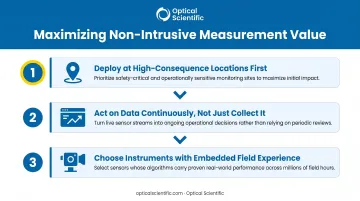
Deploy at high-consequence locations first — sites where maintenance access is difficult, safety hazards are present, or process interruption for servicing carries the highest cost. These are the points where maintenance-free operation produces the greatest financial return.
Act on the measurement data, not just collect them — instrument health indicators, trend data, and self-diagnostic outputs should feed into operations and maintenance planning. Continuous data that sits unreviewed in a historian delivers a fraction of its potential value.
Choose instruments with embedded field experience — OSI's sensors carry over 800 million field hours of validated performance data built into their algorithms, with deployments across airports, power plants, refineries, DOT highway networks, NOAA marine buoys, and polar research stations. That accumulated field history shapes how the sensors classify precipitation, compensate for optical contamination, and flag drift — not as a claimed specification, but as demonstrated, embedded behavior.
For organizations making their first deployment of non-intrusive optical measurement, OSI's product lines come with NIST-certified algorithms, EPA-accepted compliance records, and FAA certification already in place — removing the validation burden that often slows adoption in regulated environments.
Conclusion
The advantages of non-intrusive measurement instrumentation — lower maintenance burden, reduced safety exposure, and continuous data reliability — accumulate over the operational life of the instrument. They're not realized on day one. They're realized at year three when a sensor in a remote location hasn't required a service visit, or at year five when a compliance audit finds no gaps in the monitoring record.
Instrument selection is a long-term cost and risk decision. Instruments that run continuously without process contact, physical intervention, or calibration drift change the economics of monitoring at scale — particularly for organizations managing multiple installations across demanding environments.
Non-intrusive measurement should be treated as an ongoing operational practice: deployed where conditions demand it, integrated into monitoring workflows, and reviewed consistently. The organizations that get the most value from these instruments are the ones that plan for where and how they're used — not just what they cost to purchase.
Frequently Asked Questions
What is the difference between intrusive and non-intrusive measurement?
Intrusive measurement requires physical contact with or penetration into the process medium, such as a probe inserted into a gas stream or a sensor in direct fluid contact. Non-intrusive measurement captures data from outside the process boundary: no penetration, no moving parts contacting the medium, and no process interruption for installation or servicing.
What is an intrusive measurement?
An intrusive measurement is one where the sensing element physically enters or contacts the process being measured. Examples include thermowell-mounted temperature sensors, pitot tube flow meters, and sampling probes in emissions stacks.
What is a non-intrusive method of assessment?
A non-intrusive method of assessment uses external sensors, optical techniques, or remote measurement technologies to evaluate a process without physical contact or disruption. The instrument operates at or beyond the process boundary, preserving containment and allowing continuous measurement while the process runs.
What industries benefit most from non-intrusive measurement instrumentation?
Industries with 24/7 operations, hazardous process conditions, remote deployment environments, or strict regulatory reporting requirements gain the most — including aviation, power generation, oil and gas, environmental monitoring, transportation infrastructure, and government or military applications.
Are non-intrusive instruments as accurate as intrusive ones?
Modern non-intrusive instruments, particularly optical designs, match or exceed intrusive alternatives for stack gas and emissions monitoring. OSI's OFS series achieves ±2% accuracy with NIST-certified algorithms unaffected by pressure, temperature, or moisture — and without the calibration drift caused by fouling or mechanical wear.
How does non-intrusive measurement instrumentation support regulatory compliance?
EPA 40 CFR Part 75 requires continuous, validated measurement data from covered emissions sources — periodic manual readings cannot satisfy this requirement. Non-intrusive continuous sensors provide the uninterrupted data record needed for regulatory reporting, with built-in diagnostics that flag drift and maintain data integrity for audit defense.