Yet most professionals who interact with rain detection data understand the output, not the mechanism. That gap causes real problems: wrong sensor selected for the deployment environment, incorrect placement, misread data. A highway RWIS sensor that false-triggers on dew delivers the same alert as one detecting a genuine ice storm — the downstream consequence is very different.
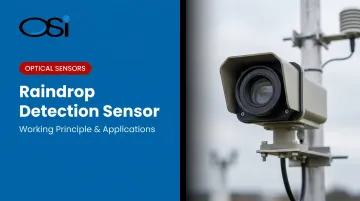
This article explains how raindrop detection sensors actually work, what distinguishes one detection technology from another, and where each type belongs.
Key Takeaways
- A raindrop detection sensor converts water contact — or a raindrop's passage through an optical beam — into a measurable electrical or optical signal.
- Four detection technologies exist: resistive, capacitive, optical infrared, and optical scintillation-based.
- Basic sensors output a binary rain/no-rain signal; professional-grade units deliver calibrated precipitation rate, accumulation, and type in real time.
- Applications span from irrigation shutoff and automotive wipers to FAA-certified airport weather systems and state DOT road weather networks.
What Is a Raindrop Detection Sensor?
A raindrop detection sensor identifies the presence of rainfall by detecting physical changes — typically in electrical conductivity, light transmission, or optical signal behavior — caused by water entering the sensor's detection zone. That definition sets it apart from a rain gauge, which measures cumulative volume over time rather than detecting presence or onset in real time.
The operational problem these sensors solve is response time. Manual observation and periodic measurement cannot react fast enough to sudden rainfall. An irrigation controller that waits for a human to notice rain will already have wasted water. An airport weather system that lags by several minutes creates a safety gap for departing and arriving aircraft.
What a raindrop sensor is not:
- A humidity or moisture sensor — those measure ambient vapor, not precipitation
- A tipping bucket gauge — that measures accumulated depth, not instantaneous rate
- A disdrometer — which characterizes drop size distribution in research applications
Each of those alternatives serves a different function. What separates a true raindrop detection sensor from them is real-time onset detection — and that gap widens considerably between consumer and professional-grade implementations.
A basic detection module — the kind used in hobby electronics — outputs only a binary rain/no-rain signal and cannot distinguish a drizzle from a downpour. Professional sensors, including optical scintillation-based instruments, measure precipitation rate, intensity, and precipitation type as a single continuous output.
How Does a Raindrop Detection Sensor Work?
Raindrop sensors operate through a defined sequence: detect water's physical arrival, generate a signal change, process the signal, and deliver an output. The quality of each stage depends on the underlying sensing technology.
Detection Trigger
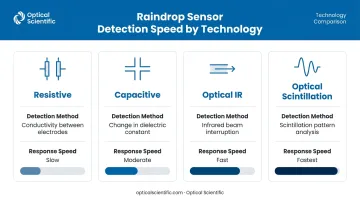
Detection begins the moment water interacts with the sensor's measurement zone. In resistive sensors, water on a conductive surface bridges the gap between electrodes, causing a voltage drop the circuit reads as rain. In optical sensors, a raindrop either interrupts a light beam or scatters light away from the receiver — both are passive, continuous processes.
Response speed varies considerably. Optical scintillation sensors can detect precipitation within milliseconds of a raindrop entering the beam path. Resistive sensors require sufficient water accumulation to actually bridge conductors, introducing a surface-threshold delay. For early-onset detection, which is critical in aviation and highway safety, that delay has operational consequences.
Core Sensing Mechanism
Resistive and capacitive sensors work by changing circuit properties. Water bridges or separates conductive paths; a comparator circuit (such as the LM393 op-amp used in basic modules) compares the resulting voltage against a calibrated threshold and outputs a digital HIGH or LOW signal.
Optical infrared sensors pair an infrared emitter with a photodetector. Water on a glass surface causes total internal reflection disruption or light scattering, reducing the signal intensity received at the detector below a set threshold. This principle underlies automotive rain-sensing windshields.
Optical scintillation sensors, the standard in professional meteorological and aviation applications, don't require surface contact at all. The sensor projects a modulated infrared beam across a detection volume. When a raindrop passes through that beam, it causes scintillation: rapid, characteristic fluctuations in light intensity. NOAA's ASOS present weather sensor uses a coherent infrared beam approximately 50 mm in diameter, detecting rain energy in the 1,000–4,000 Hz frequency band.
These sensors detect precipitation in the air column, so water never needs to physically touch the sensor surface.
OSI's ORG-815-DS uses this same scintillation principle: drops passing through an infrared LED beam produce characteristic optical irregularities that a microprocessor converts to precipitation rate.
Signal Processing and Output
Raw signal handling splits clearly by sensor grade:
- Basic modules pass the comparator output directly as a digital on/off signal or an analog voltage proportional to moisture level
- Professional sensors apply digital signal processing (DSP) to filter noise, classify precipitation type, calculate rate, and deliver calibrated outputs
That distinction matters in the field. OSI's all-digital DSP architecture eliminates temperature-sensitive analog components, removing the drift that affects field calibration in competing systems. The output includes precipitation type, instantaneous rate (updated every 10 seconds), and accumulation data — delivered via RS-232, MODBUS RTU, RS-485, or Ethernet depending on deployment requirements.
Types of Raindrop Detection Sensors
Four primary detection technologies define the sensor landscape, each suited to different precision requirements and deployment environments.
| Type | Detection Method | Contact Required | Typical Use |
|---|---|---|---|
| Resistive | Conductivity change between electrodes | Yes | Basic automation, DIY projects |
| Capacitive | Capacitance change from water presence | Yes | Consumer weather stations, automotive |
| Optical IR (TIR) | Light scatter from water on glass surface | Yes (surface) | Automotive windshield systems |
| Optical scintillation | Light fluctuation from drops in beam path | No | Aviation AWOS, RWIS, meteorological stations |
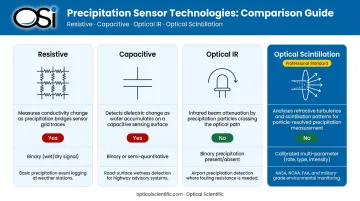
Contact-Based vs. Non-Contact: Why It Matters
Resistive and capacitive sensors require water to physically accumulate on the sensing surface. That creates two problems in unattended deployments:
- Surface fouling — dirt, bio-film, and mineral deposits accumulate over time, increasing the risk of false positives or missed events
- Dew and condensation — surface moisture from non-precipitation sources can trigger false rain alerts, particularly at night
Non-contact optical scintillation sensors detect precipitation in the air column, so surface contamination on the lens does not cause false precipitation readings. OSI's scintillation-based sensors, for instance, use AI-based algorithms to automatically compensate for dust, water droplets, and ice on optical surfaces, eliminating scheduled lens cleaning and achieving an MTBF exceeding 80,000 hours.
Output Quality Across Types
The working principle directly determines what data the sensor can produce:
- Resistive/capacitive: Binary threshold signal: rain or no rain
- Optical IR: Presence detection with limited intensity inference
- Optical scintillation: Continuous calibrated output: precipitation rate, accumulation, and type classification (rain, snow, drizzle, freezing rain, sleet, hail)
WMO-No. 8 sets professional precipitation intensity uncertainty requirements at 0.1 mm/h for rates between 0.2–2 mm/h, and 5% for rates above 2 mm/h. Only scintillation-based sensors routinely meet these thresholds in field deployments.
Where Raindrop Detection Sensors Are Used
Raindrop sensors appear wherever rainfall directly triggers a safety, compliance, or operational response — not just in weather monitoring.
Aviation and Airport Operations
NOAA operates approximately 950 ASOS sites across the U.S. as the primary surface weather observing network, a joint NWS/FAA/DOD program. These systems detect precipitation type and accumulation in real time, feeding the METAR reports that pilots and air traffic control rely on for departure and approach decisions.
FAA Advisory Circular 150/5220-16E governs non-federal AWOS installations and distinguishes between two separate functions: Present Weather Detection and Precipitation Accumulation. This distinction reflects the operational difference between detecting onset and measuring volume. OSI's FAA-certified AWOS-AV systems incorporate precipitation detection as a core measurement parameter for these environments.
Highway and Transportation
State Departments of Transportation operate Road Weather Information Systems (RWIS) consisting of Environmental Sensor Stations (ESS) that monitor pavement and atmospheric conditions. FHWA reports that state DOTs collectively own 2,499 ESS nationwide. Active deployments using OSI sensors include:
- Ohio DOT — collects RWIS observations every 15 minutes
- Wisconsin DOT — operates 61 remote weather stations with pavement sensors
- Wyoming, Vermont, Maryland, and New Hampshire DOTs — all run active precipitation monitoring networks
FHWA guidance specifies that optical precipitation sensors measuring rate, type, and amount should be installed at 10 ft (3 m) height and away from traffic due to vibration sensitivity.
Agriculture and Irrigation Management
Rain sensors connected to irrigation controllers suspend watering automatically during rainfall — conserving water and preventing overwatering damage. Several states mandate their use:
- Florida — Statute 373.62 requires technology that interrupts irrigation during periods of sufficient moisture for any automatic landscape irrigation system installed
- Texas — TCEQ irrigation standards require a rain or moisture shutoff device on new automatic systems
- New Jersey — N.J.S.A. 52:27D-123.13 mandates operational rain sensor devices on newly installed automatic lawn sprinkler systems
A University of Florida study found that three of four rain sensors produced water savings of 69%–92% compared to uncontrolled irrigation.

Environmental and Meteorological Monitoring
OSI's ORG sensors have been deployed on NOAA data buoys in the Pacific Ocean as part of the TRMM (Tropical Rainfall Measurement Mission) project and on NASA research ships — environments where sensors must operate unattended in open-ocean conditions for extended periods.
Industrial applications extend across several regulated sectors:
- Satellite dish rain blowers — removing water from antenna apertures to maintain signal integrity
- Power plant compliance reporting — supporting environmental monitoring obligations
- Stormwater management — meeting EPA Multi-Sector General Permit requirements tied to qualifying precipitation events
Frequently Asked Questions
What does a raindrop sensor do?
A raindrop sensor detects rainfall by measuring a physical change caused by water — conductivity shift, light scatter, or optical signal fluctuation — and outputs a signal that triggers automated responses. Depending on sensor type, those responses include closing irrigation valves, activating windshield wipers, or generating aviation weather reports.
How accurate are raindrop sensors?
Accuracy varies significantly by technology. Basic resistive sensors detect rain onset but cannot measure intensity or distinguish precipitation types. Professional optical and scintillation-based sensors meet WMO-specified uncertainty requirements: 0.1 mm/h for rates between 0.2–2 mm/h and 5% for rates above 2 mm/h. OSI's APG-815-DS measures rainfall as light as 0.1 mm/hr with a resolution of 0.001 mm.
What are the different types of raindrop detection sensors?
The four main types are resistive, capacitive, optical infrared, and optical scintillation-based. Resistive and capacitive sensors require direct water contact; optical scintillation sensors detect precipitation in the air column without surface contact, making them the standard for professional meteorological and aviation applications.
How does an optical raindrop sensor work differently from a resistive sensor?
A resistive sensor requires water to bridge conductive electrodes on its surface before detection occurs. An optical sensor detects rain by measuring changes in light transmission or scatter caused by water droplets in the optical path — making it faster, non-contact, and immune to surface contamination that causes false readings in resistive types.
Where are raindrop detection sensors used professionally?
Key professional deployments include airports (AWOS systems for aviation weather reporting), highway networks (RWIS for road weather management), NOAA and National Weather Service meteorological stations, agricultural irrigation systems, and industrial facilities where precipitation data supports environmental compliance or stormwater management.
What factors affect reliability in the field?
The main factors are sensor type (contact-based sensors are prone to surface fouling and condensation false positives), installation height and sky exposure, calibration requirements, operating temperature range, and whether the sensor includes built-in self-diagnostics. Optical scintillation sensors with no moving parts and continuous self-test capability are best suited for long-term unattended operation.