FHWA data shows fog alone causes more than 38,700 crashes, 600 deaths, and 16,300 injuries on U.S. roads each year. In aviation, low ceilings and poor visibility account for 28–35% of weather-related delays. These aren't abstractions — they're the operational stakes attached to every visibility sensor procurement decision.
The challenge is that poor visibility isn't one condition. Fog, freezing rain, blowing dust, wildfire smoke, and industrial haze each behave differently in the atmosphere and stress optical sensors in different ways. No single sensor excels across all of them. This guide walks through what visibility sensors are, how to evaluate them against real-world selection criteria, and how to match sensor capabilities to your specific atmospheric threat.
Key Takeaways
- Visibility sensors measure atmospheric optical clarity and report MOR, directly driving safety-critical decisions across aviation, transportation, maritime, and industrial operations.
- Poor visibility from fog, precipitation, dust, or smoke affects optical sensor technologies differently; particle type determines which sensor performs best.
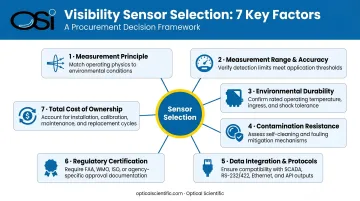
- Selection hinges on seven factors: measurement principle, range, accuracy, environmental durability, contamination resistance, integration capability, and certification requirements.
- Sensors with no moving parts, contamination-insensitive measurement, and built-in self-diagnostics offer major operational advantages in remote or unmanned deployments.
- Match the sensor to your dominant visibility threat — don't procure a high-spec general-purpose unit when the real performance question is site-specific.
What Are Visibility Sensors and How Do They Work?
Visibility sensors — also called present weather sensors — measure the optical properties of the atmosphere to report how far light travels before it's scattered or extinguished by airborne particles. The result is expressed as MOR (Meteorological Optical Range) in meters, or as RVR (Runway Visual Range) in aviation applications.
The Three Main Sensor Technologies
| Technology | How It Works | Best For |
|---|---|---|
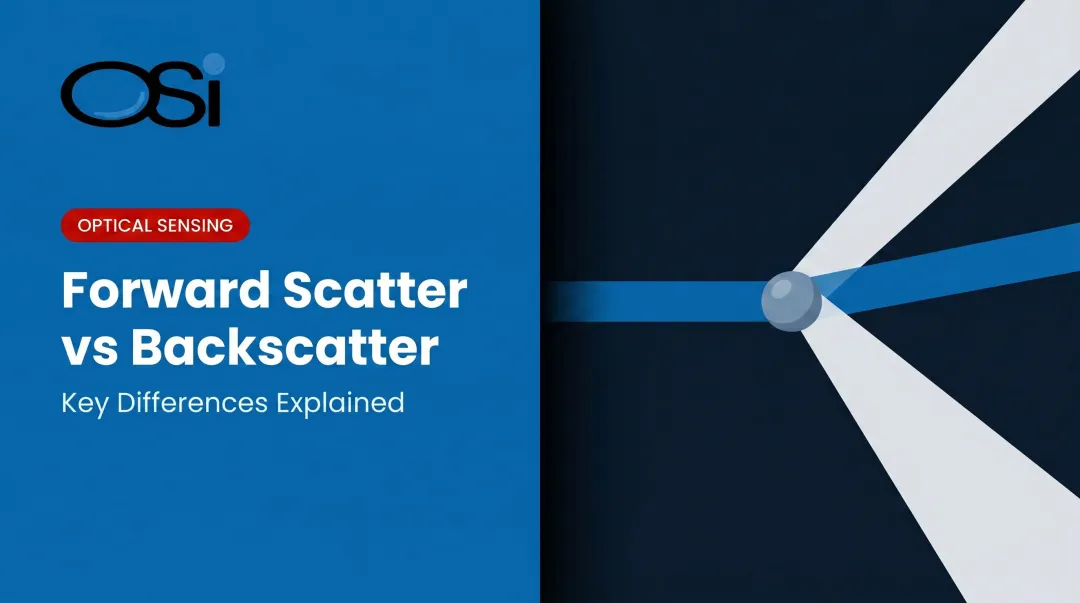
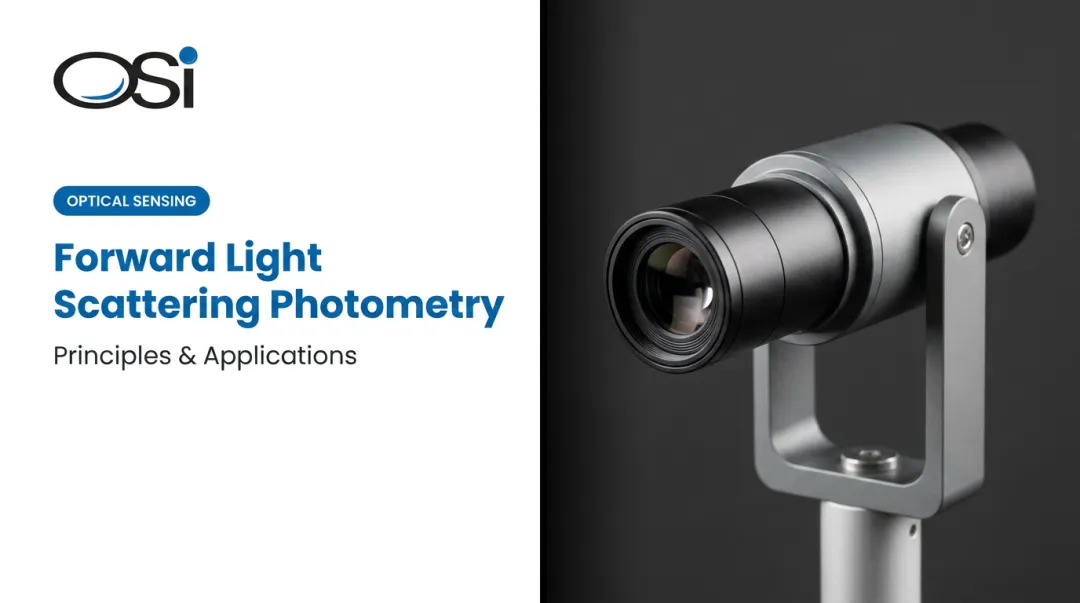
| Forward scatter | Measures light scattered from a small sample volume, typically at 20–50° angles | Fog, light precipitation; compact and widely deployed |
| Transmissometer | Measures light extinction across a fixed baseline path between transmitter and receiver | High-accuracy reference applications; WMO-traceable standard |
| Scintillation-based | Detects fluctuations in light intensity along a path caused by particles and turbulence | All-condition monitoring; inherently insensitive to gradual optics contamination |
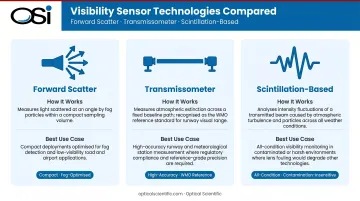
According to WMO-No. 8, forward scatter sensors are generally preferred over backscatter designs because measurement uncertainty is smaller, though transmissometers remain the calibration reference standard.
Scintillation-based sensors take a different approach: they measure relative changes in light intensity rather than absolute levels. That distinction matters in the field, because they maintain accuracy even when optic surfaces accumulate gradual contamination.
What Counts as "Poor Visibility"?
The primary atmospheric causes span a wide range of particle types and behaviors:
- Advection and radiation fog: liquid water droplets, most common in coastal and valley environments
- Freezing fog and ice fog: different scattering phase behavior that requires heated optics to prevent ice accumulation on sensor surfaces
- Rain and snow: deposits water or ice directly on optics during the exact moments accurate readings matter most
- Blowing dust and sand: dry fine particulates that scatter light differently than water droplets
- Wildfire smoke: fine carbonaceous aerosols (soot-based particles) with distinct optical properties
- Industrial haze and emissions: chemical particulates that may also corrode sensor housings
Each condition creates a different particle size distribution and optical signature. For that reason, sensor selection should start with characterizing the dominant local visibility threat at your site, not just comparing nominal specifications on a datasheet.
Key Factors When Choosing a Visibility Sensor
Sensor specs must be evaluated against the specific atmospheric threats, operational requirements, and data use cases at your deployment site.
Detection Technology and Measurement Principle
The underlying physics determines how a sensor responds to different aerosol types. Forward scatter sensors perform well in fog and light precipitation but can be affected by heavy rain or accumulated contamination on optics. A 2024 DOT evaluation noted that forward scatter meters are generally less sensitive to window contamination than transmissometers — but neither is immune.
Scintillation-based sensors measure light intensity fluctuations, not absolute light levels. Even with a fraction of the light reaching the detector, the sensor can accurately characterize atmospheric conditions. This fundamental design characteristic makes contamination on lenses a much smaller problem — and is the reason OSI's OWI-series sensors require no scheduled optics cleaning, even in harsh deployment environments.
WMO guidance specifies which measurement approaches are appropriate for different applications. For aviation, transmissometer equivalency is the reference baseline. For highway RWIS networks and maritime stations, forward scatter and scintillation-based designs are both accepted — but condition-specific field validation should be requested from any vendor before finalizing selection.
Measurement Range and Accuracy
Aviation sensors must cover roughly 25 m to 10,000 m MOR, with the most consequential accuracy requirements at the low end. Category IIIa ILS operations require RVR not less than 700 ft; Category IIIb requires 150–700 ft. Errors in the sub-200 m range carry direct flight safety implications.
WMO sets achievable MOR uncertainty at the larger of 20 m or 20%, and NOAA CO-OPS guidance puts automated visibility sensor accuracy at 10–20% operationally. Before accepting any vendor's accuracy claims, ask for:
- Published datasheet accuracy at low-visibility endpoints (e.g., 100 m MOR)
- Third-party or regulatory validation data for the specific model
- The conditions under which accuracy specifications were measured (fog only? dust? precipitation?)
Environmental Durability and Contamination Resistance
Sensors deployed in poor visibility environments face exactly the conditions that degrade sensor performance. Two requirements are non-negotiable:
- IP rating: Verified IEC 60529 rating (IP64 or higher for most outdoor deployments; IP66/IP67 for severe exposure)
- Operating temperature range: Must cover worst-case local extremes, including potential icing events
OSI's OWI-430 DSP-WIVIS, for example, operates from –50°C to +60°C with dual self-regulating lens heaters that automatically adjust current draw based on ambient temperature — preventing frost, dew, and snow buildup without manual intervention.
Cold-climate performance is worth verifying with deployment references, not just datasheets. OSI sensors have been deployed by the Australian Antarctic Division, providing direct validation in one of the most extreme environments on the planet.
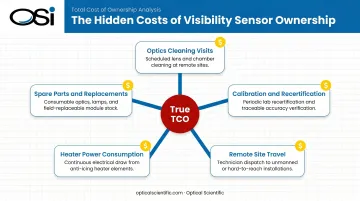
Contamination is often the hidden total cost of ownership (TCO) driver. Sensors that require frequent cleaning — every few weeks in coastal or dusty environments — generate ongoing labor and travel costs that can easily exceed the hardware cost over a five-year period. Evaluate contamination tolerance explicitly, not just IP rating.
Data Integration and Communication Protocols
Integration requirements should be confirmed before purchase, not after. Verify compatibility with:
- Standard protocols: RS-232, RS-485, Ethernet, MODBUS RTU
- Output formats: WMO/NWS present weather codes, raw MOR values, METAR-formatted outputs for AWOS systems
- Remote diagnostics: Built-in self-diagnostics that report sensor health over the data link
OSI's OWI series supports RS-232 as standard, with RS-485, Ethernet, and cellular modem options for remote installations. MODBUS RTU over RS-232 enables direct SCADA integration for industrial plant deployments. The sensors continuously self-test once per minute and report fault conditions — including lens contamination status ("CL" codes) and error states — without requiring on-site visits.
Regulatory Certification
Certification requirements should be confirmed at the start of the selection process. Deploying a non-certified sensor in a safety-critical application creates regulatory liability regardless of technical performance.
| Application | Relevant Standard |
|---|---|
| Aviation AWOS/RVR | FAA AC 150/5220-16E; FAA Order 8400.13E for CAT II/III |
| Meteorological networks | WMO-No. 8 (CIMO Guide) |
| European deployments | CE marking; RoHS Directive 2011/65/EU |
| Industrial emissions monitoring | EPA 40 CFR Part 75; EPA Performance Specification 1 (COMS) |
Industrial buyers should note that a meteorological visibility sensor and an EPA Continuous Opacity Monitoring System (COMS) serve different regulatory purposes. Optical technology overlap does not equal regulatory equivalence — they are separate compliance instruments.
Total Cost of Ownership
An Aurora Program RWIS lifecycle cost analysis found that visibility sensors average $7,195 in capital cost with an expected service life of about 8 years — but that's just the hardware. A realistic TCO model includes:
- Optics cleaning visits (frequency depends heavily on sensor technology)
- Calibration checks and recertification
- Travel to remote sites (RWIS cabinets, offshore platforms)
- Heater power consumption
- Component replacement and spare parts
Request MTBF data from every vendor before selecting. OSI's sensors carry MTBF exceeding 80,000 hours, supported by over 800 million field hours of operation across airports, highways, military installations, and research stations on every continent.
How Sensor Requirements Change by Visibility Threat
The same sensor specification may perform very differently depending on whether the primary threat is liquid-droplet fog, ice-crystal fog, rain, snow, dust, or smoke. Particle size, shape, and refractive index all affect how optical sensors respond.
Fog and Low Cloud
Liquid water droplet fog is the most operationally impactful condition for airports, maritime ports, and exposed highway corridors. Forward scatter and scintillation-based sensors both perform well in fog — but the critical differentiator is accuracy at very low MOR values (below 200 m), where go/no-go decisions are made. Ask vendors specifically for validation data at dense fog conditions, not just clear-air calibration results.
Rain and Snow
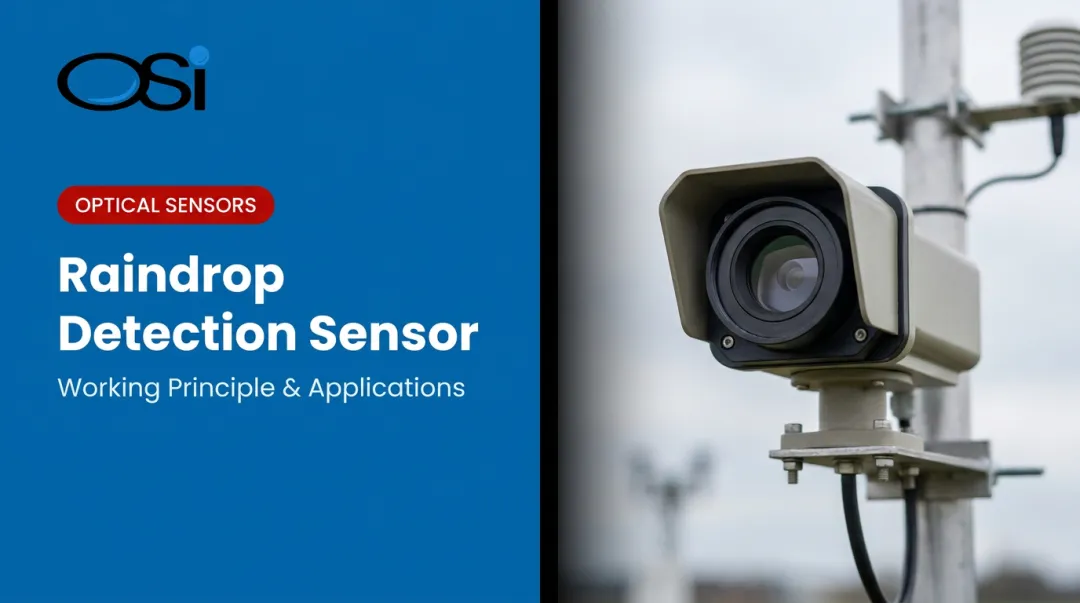
Precipitation creates a dual problem: it degrades visibility AND deposits water or ice directly on sensor optics. Sensors that depend on clean optics for accurate scatter measurement are most vulnerable precisely when accurate readings matter most.
For precipitation-prone deployments, three capabilities move from "nice to have" to non-negotiable:
- Contamination compensation to correct readings when optics are wet or iced
- Heated optics to prevent ice accumulation on measurement surfaces
- Diagnostic alarming to flag when sensor performance is degraded
Blowing Dust, Smoke, and Industrial Haze
Dry fine particulates behave very differently from water droplets. Some sensor calibration algorithms are optimized specifically for water-droplet aerosols and may underperform when the dominant threat is dust or smoke. For desert highway corridors, wildfire-prone regions, or industrial plant perimeters, a sensor tuned only for water-droplet aerosols will consistently misread conditions.
OSI's OWI-430-DSH variant addresses this directly: its triple-aperture measurement system actively discriminates between haze/fog and dust/smoke, rather than applying a single aerosol assumption to all conditions.
Industrial deployments add another layer of risk — chemical corrosion. OSI's OFS and LOA series sensors for refineries, smelters, and chemical plants use air-purged housings and corrosion-resistant materials specifically to counter this.
How OSI's Sensors Address These Selection Factors
Optical Scientific, Inc. (OSI), founded in 1985 and based in Gaithersburg, MD, has built its product line around the specific failure modes that make visibility sensing difficult in real deployments.
OSI's OWI-430 DSP-WIVIS is the company's primary present weather and visibility sensor. It uses a triple-aperture optical system combining in-beam scintillation detection, off-axis forward scatter measurement, and ambient light sensing, reporting over 50 NWS/WMO weather codes.
The OWI-650 LP-WIVIS is the low-power variant, originally designed for military field use and now deployed at solar-powered remote stations.
Both models map directly to the selection factors covered above:
- Contamination insensitivity: Scintillation-based measurement detects light fluctuations, not absolute levels — accurate even with partial optic obscuration; no scheduled cleaning required
- No moving parts: Eliminates the most common mechanical failure mode in outdoor sensor deployments
- MTBF > 80,000 hours: Validated across airports, state DOT RWIS networks (Maryland, Ohio, Wisconsin, Vermont, New Hampshire DOTs), NASA facilities, and maritime applications
- All-digital DSP design: No temperature-sensitive analog components; no field calibration required; maintains accuracy across the full –50°C to +60°C operating range
- Built-in self-diagnostics: Continuous self-test every minute; fault codes transmitted over data link without on-site visits
- FAA-certified AWOS-AV systems: Meets FAR 91.171 and FAR 91.175 standards; ICAO compliant; used in aviation applications from commercial airports to private helipads
For deployments outside standard configurations — offshore platforms, polar research stations, industrial emissions monitoring — OSI's field engineering teams handle on-site installation, integration, and commissioning.
Frequently Asked Questions
What is a visibility sensor?
A visibility sensor is a meteorological instrument that measures atmospheric optical clarity, reporting Meteorological Optical Range (MOR) in meters. Deployed across aviation, transportation, maritime, and weather monitoring, they deliver the real-time data behind safety-critical operational decisions.
What are the main types of visibility sensors?
The four main types are forward scatter sensors, transmissometers (extinction-based), scintillation-based optical sensors, and present weather sensors that combine visibility measurement with precipitation type identification. Each has distinct strengths for different environmental conditions and regulatory applications.
How do visibility sensors help in fog conditions?
Visibility sensors don't physically reduce fog — they accurately measure and report real-time MOR so that operations can respond appropriately: adjusting runway approach categories, triggering highway dynamic message signs, or issuing maritime restricted-visibility alerts.
What measurement range do aviation visibility sensors need?
Aviation visibility sensors typically measure from approximately 25 m to 10,000 m MOR. FAA Category IIIa operations require RVR not less than 700 ft; Category IIIb requires 150–700 ft. FAA AC 150/5220-16E and FAA Order 8400.13E govern specific accuracy requirements for certified AWOS systems.
How often do visibility sensors need maintenance?
It depends on the technology. Forward scatter sensors in dusty or coastal environments may require optics cleaning every few weeks. Scintillation-based sensors like OSI's OWI series use contamination-insensitive measurement and adaptive algorithms, eliminating scheduled cleaning requirements entirely.
What certifications matter when selecting a visibility sensor?
Key certifications by application:
- FAA AC 150/5220-16E — aviation AWOS systems
- WMO CIMO Guide — meteorological networks
- CE and RoHS — European jurisdiction deployments
- EPA 40 CFR Part 75 / Performance Specification 1 — industrial stack and emissions monitoring
Confirm applicable requirements before finalizing your sensor selection.